On Unix-like operating systems, the smbclient command launches an ftp-like client to access SMB/CIFS resources on servers.
Smb-scripts is a collection of Bash Scripts that uses Samba and LDAP Client commands. These scripts are used by Samba to manage it using Microsoft Tools (like usrmgr and svrmgr) and a LDAP database as information repository. Multichannel - aggregation of network bandwidth and fault tolerance if multiple paths are available between client and server SMB Direct - adds RDMA networking support for high performance, with low latency and low CPU use Encryption - Provides end-to-end encryption and protects from eavesdropping on untrustworthy networks. SMB/CIFS Clients: Linux CIFS VFS; Dave (Macintosh) (obslete) QNX (Samba Server/Client) IBM LAN Client 2.x; Sharity; Microsoft's various clients: including WFWG3.11, LanMan for DOS, LanMan for OS/2 (v1.2, 1.3 or 2.x, Warp 3.0, not Warp connect, ), MSClient 3.0 for DOS.Check the README.NOW file for details. Please note: Windows 2000, Windows XP, Windows NT, Windows 95, OS/2 Warp Connect.
Description

smbclient is a client that is part of the Samba software suite. It communicates with a LAN Manager server, offering an interface similar to that of the ftp program. Operations include things like getting files from the server to the local machine, putting files from the local machine to the server, retrieving directory information from the server and so on.
Syntax
Options
| servicename | servicename is the name of the service you want to use on the server. A service name takes the form serverservice where server is the netbios name of the LAN Manager server offering the desired service and service is the name of the service offered. So to connect to the service 'printer' on the LAN Manager server 'lanman', you would use the servicename lanmanprinter. Note that the server name required isn't necessarily the hostname of the server. The name required is a LAN Manager server name, which may or may not be the same as the hostname of the machine running the server. |
| password | password is the password required to access the specified service on the specified server. If supplied, the -N option (suppress password prompt) is assumed. There is no default password. If no password is supplied on the command line (either here or using the -U option (see below)) and -N is not specified, the client will prompt for a password, even if the desired service does not require one. (If no password is required, press Enter to provide a null password.) Note: Some servers (including OS/2 and Windows for Workgroups) insist on an uppercase password. Lowercase or mixed case passwords may be rejected by these servers. Be cautious about including passwords in scripts. |
| -A | This parameter, if specified, causes the maximum debug level to be selected. Be warned that this generates prodigious amounts of debug data. There is also a security issue involved, as at the maximum debug level cleartext passwords may be written to some log files. |
| -L | This option allows you to look at what services are available on a server. You use it as 'smbclient -L host' and a list should appear. The -I option may be useful if your netbios names don't match your tcp/ip hostnames or if you are trying to reach a host on another network. For example: will list the shares available on Microsoft's public server. |
| -M | This options allows you to send messages, using the 'WinPopup' protocol, to another computer. Once a connection is established you then type your message, pressing ^D (control-D) to end. If the receiving computer is running WinPopup the user will receive the message and probably a beep. If they are not running WinPopup the message will be lost, and no error message will occur. The message is also automatically truncated if the message is over 1600 bytes, as this is the limit of the protocol. One useful trick is to cat the message through smbclient. For example: cat mymessage.txt | smbclient -M FRED will send the message in the file 'mymessage.txt' to the machine FRED. You may also find the -U and -I options useful, as they allow you to control the FROM and TO parts of the message. See the message command section of smb.conf(5) for a description of how to handle incoming WinPopup messages in Samba. Copy WinPopup into the startup group on your WfWg PCs if you want them to always be able to receive messages. |
| -E | This parameter, if specified, causes the client to write messages to the standard error stream (stderr) rather than to the standard output stream. By default, the client writes messages to standard output, often the user's tty. |
| -IIP number | IP number represents the IP number of the server to connect to. It should be specified in standard 'a.b.c.d' notation. Normally the client will attempt to locate the specified LAN Manager server by looking it up: that is, broadcasting a request for the given server to identify itself. Using this parameter will force the client to assume that the server is on the machine with the specified IP number. There is no default for this parameter. If not supplied, it will be determined automatically by the client as described above. |
| -N | If specified, this parameter suppresses the normal password prompt from the client to the user. This is useful when accessing a service that does not require a password. Unless a password is specified on the command line or this parameter is specified, the client will request a password. |
| -Osocket-options | See the socket options section of smb.conf(5) for details. |
| -P | If specified, the service requested will be connected to as a printer service rather than as a normal filespace service. Operations such as put and get will not be applicable for such a connection. By default, services will be connected to as NON-printer services. |
| -Uusername | username is the username that will be used by the client to make a connection, assuming your server is running a protocol that allows for usernames. Some servers are fussy about the case of this name, and some insist that it must be a valid netbios name. If no username is supplied, it will default to an uppercase version of the environment variable USER or LOGNAME in that order. If no username is supplied and neither environment variable exists the username will be empty. If the service you are connecting to requires a password, it can be supplied using the -U option, by appending a percent symbol ('%') then the password to username. For example, to attach to a service as user 'fred' with password 'secret', you would specify -U fred%secret on the command line. Note that there are no spaces around the percent symbol. If you specify the password as part of username then the -N option (suppress password prompt) is assumed. If you specify the password as a parameter AND as part of username then the password as part of username takes precedence. Putting nothing before or nothing after the percent symbol will cause an empty username or an empty password to be used, respectively. Note: Some servers (including OS/2 and Windows for Workgroups) insist on an uppercase password. Lowercase or mixed case passwords may be rejected by these servers. Be cautious about including passwords in scripts. |
| -ddebuglevel | debuglevel is an integer from 0 to 5. The default value if this parameter is not specified is zero. The higher this value, the more detail will be logged to the log files about the activities of the client. At level 0, only critical errors and serious warnings will be logged. Level 1 is a reasonable level for day to day running - it generates a small amount of information about operations carried out. Levels above 1 will generate considerable amounts of log data, and should only be used when investigating a problem. Levels above 3 are designed for use only by developers and generate HUGE amounts of log data, that can be extremely cryptic. |
| -llog basename | If specified, log basename specifies a base file name into which operational data from the running client will be logged. The default base name is specified at compile time. The base name is used to generate actual log file names. For example, if the name specified was 'log', the following files would be used for log data: log.client.debug (containing debugging information) log.client.in (containing inbound transaction data) log.client.out (containing outbound transaction data) The log files generated are never removed by the client. |
| -nnetbios-name | By default, the client will use the local machine's hostname (in uppercase) as its netbios name. This parameter allows you to override the hostname and use whatever netbios name you want. |
| -Wworkgroup | Override what workgroup is used for the connection. This may be needed to connect to some servers. |
| -pport-number | port-number is a positive integer value. The default value if this parameter is not specified is 139. This number is the port number that will be used when making connections to the server. The standard (well-known) port number for the server is 139, hence the default. This parameter is not normally specified. |
| -Ttar-options | where tar-options consists of one or more of c, x, I, X, b, g, N or a; used as: c: Create a tar file on UNIX. Must be followed by the name of a tar file, tape device or '-' for standard output. (May be useful to set debugging low (-d0)) to avoid corrupting your tar file if using '-'). Mutually exclusive with the x flag. x: Extract (restore) a local tar file back to a share. Unless the -D option is given, the tar files will be restored from the top level of the share. Must be followed by the name of the tar file, device or '-' for standard input. Mutually exclusive with the c flag. I: Include files and directories. Is the default behavior when file names are specified above. Causes tar files to be included in an 'extract' or 'create' (and therefore everything else to be excluded). See example below. File name globbing does not work for included files for extractions (yet). X: Exclude files and directories. Causes tar files to be excluded from an extract or create. See example below. File name globbing does not work for excluded files (yet). b: Blocksize. Must be followed by a valid (greater than zero) blocksize. Causes tar file to be written out in blocksize*TBLOCK (usually 512 byte) blocks. g: Incremental. Only back up files that have the archive bit set. Useful only with the c flag. N: Newer than. Must be followed by the name of a file whose date is compared against files found on the share during a create. Only files newer than the file specified are backed up to the tar file. Useful only with the c flag. a: Set archive bit. Causes the archive bit to be reset when a file is backed up. Useful with the g (and c) flags. Examples: Restore from tar file backup.tar into myshare on mypc (no password on share). Restore everything except users/docs Create a tar file of the files beneath users/docs. |
| -Dinitial-directory | Change to initial-directory before starting. Probably only of any use with the tar (-T) option. |
| -ccommand-string | command-string is a semicolon-separated list of commands to be executed instead of prompting from stdin.-N is implied by -c. This is particularly useful in scripts and for printing stdin to the server, e.g., -c 'print -'. |
Operations
Once the client is running, the user is presented with a prompt, 'smb: >'. The backslash ('') indicates the current working directory on the server, and will change if the current working directory is changed.
The prompt indicates that the client is ready and waiting to carry out a user command. Each command is a single word, optionally followed by parameters specific to that command. Command and parameters are space-delimited unless these notes specifically state otherwise. All commands are case-insensitive. Parameters to commands may or may not be case sensitive, depending on the command.
You can specify file names which have spaces in them by quoting the name with double quotes, for example 'a long file name'.
Parameters shown in square brackets (eg., '[parameter]') are optional. If not given, the command will use suitable defaults. Parameters shown in angle brackets (eg., '<parameter>') are required.
Note that all commands operating on the server are actually performed by issuing a request to the server. Thus the behavior may vary from server to server, depending on how the server was implemented.
The commands available are given here in alphabetical order.
| ? [command] | If command is specified, the ? command displays a brief informative message about the specified command. If no command is specified, a list of available commands will be displayed. |
| ! [shell-command] | If shell-command is specified, the ! command will execute a shell locally and run the specified shell-command. If no command is specified, a shell will be run. |
| cd [directory-name] | If directory-name is specified, the current working directory on the server will be changed to the directory specified. This operation will fail if for any reason the specified directory is inaccessible. If no directory-name is specified, the current working directory on the server will be reported. |
| delmask | The client will request that the server attempt to delete all files matching mask from the current working directory on the server. |
| dirmask | A list of the files matching mask in the current working directory on the server will be retrieved from the server and displayed. |
| exit | Terminate the connection with the server and exit from the program. |
| getremote-file-name [local-file-name] | Copy the file called remote-file-name from the server to the machine running the client. If specified, name the local copy local-file-name. Note that all transfers in smbclient are binary. See also the lowercase command. |
| help [command] | Same as the ? command. |
| lcd [directory-name] | If directory-name is specified, the current working directory on the local machine will be changed to the directory specified. This operation will fail if for any reason the specified directory is inaccessible. If no directory name is specified, the name of the current working directory on the local machine will be reported. |
| lowercase | Toggle lowercasing of file names for the get and mget commands. When lowercasing is toggled ON, local file names are converted to lowercase when using the get and mget commands. This is often useful when copying (for instance) MSDOS files from a server, because lowercase file names are the norm on UNIX systems. |
| lsmask | Same as the dir command. |
| maskmask | This command allows the user to set up a mask which will be used during recursive operation of the mget and mput commands. The masks specified to the mget and mput commands act as filters for directories rather than files when recursion is toggled ON. The mask specified with the mask command is necessary to filter files within those directories. For example, if the mask specified in an mget command is 'source*' and the mask specified with the mask command is '*.c' and recursion is toggled ON, the mget command will retrieve all files matching '*.c' in all directories below and including all directories matching 'source*' in the current working directory. Note that the value for mask defaults to blank (equivalent to '*') and remains so until the mask command is used to change it. It retains the most recently specified value indefinitely. To avoid unexpected results it would be wise to change the value of mask back to '*' after using the mget or mput commands. |
| mddirectory-name | Same as the mkdir command. |
| mgetmask | Copy all files matching mask from the server to the machine running the client. Note that mask is interpreted differently during recursive operation and non-recursive operation; refer to the recurse and mask commands for more information. Note that all transfers in smbclient are binary. See also the lowercase command. |
| mkdirdirectory-name | Create a new directory on the server (user access privileges permitting) with the specified name. |
| mputmask | Copy all files matching mask in the current working directory on the local machine to the current working directory on the server. Note that mask is interpreted differently during recursive operation and non-recursive operation; refer to the recurse and mask commands for more information. Note that all transfers in smbclient are binary. |
| printfile-name | Print the specified file from the local machine through a printable service on the server. See also the printmode command. |
| printmode [graphics|text] | Set the print mode to suit either binary data (such as graphical information) or text. Subsequent print commands will use the currently set print mode. |
| prompt | Toggle prompting for file names during operation of the mget and mput commands. When toggled ON, the user will be prompted to confirm the transfer of each file during these commands. When toggled OFF, all specified files will be transferred without prompting. |
| putlocal-file-name [remote-file-name] | Copy the file called local-file-name from the machine running the client to the server. If specified, name the remote copy remote-file-name. Note that all transfers in smbclient are binary. See also the lowercase command. |
| queue | Displays the print queue, showing the job id, name, size and current status. |
| quit | Same as the exit command. |
| rddirectory name | Same as the rmdir command. |
| recurse | Toggle directory recursion for the commands mget and mput. When toggled ON, these commands will process all directories in the source directory (i.e., the directory they are copying from) and will recurse into any that match the mask specified to the command. Only files that match the mask specified using the mask command will be retrieved. See also the mask command. When recursion is toggled OFF, only files from the current working directory on the source machine that match the mask specified to the mget or mput commands will be copied, and any mask specified using the mask command will be ignored. |
| rmmask | Remove all files matching mask from the current working directory on the server. |
| rmdirdirectory-name | Remove the specified directory (user access privileges permitting) from the server. |
| tarc|x[IXbgNa] | Performs a tar operation; see the -T command line option above. Behavior may be affected by the tarmode command (see below). Using g (incremental) and N (newer) will affect tarmode settings. Note that using the '-' option with tar x may not work; use the command line option instead. |
| blocksizeblocksize | Blocksize. Must be followed by a valid (greater than zero) blocksize. Causes tar file to be written out in blocksize*TBLOCK (usually 512 byte) blocks. |
| tarmodefull|inc|reset|noreset | Changes tar's behavior with regard to archive bits. In full mode, tar will back up everything regardless of the archive bit setting (this is the default mode). In incremental mode, tar will only back up files with the archive bit set. In reset mode, tar will reset the archive bit on all files it backs up (implies read/write share). |
| setmodefile nameperm=[+|-]rsha | A version of the MS-DOS 'attrib' command to set file permissions. For example, would make myfileread-only. |
Notes
Some servers are fussy about the case of supplied usernames, passwords, share names (aka service names) and machine names. If you fail to connect try giving all parameters in uppercase.
It is often necessary to use the -n option when connecting to some types of servers. For example, OS/2 LANManager insists on a valid netbios name being used, so you need to supply a valid name that would be known to the server.
smbclient supports long file names where the server supports the LANMAN2 protocol.
Environment Variables
The variable USER may contain the username of the person using the client. This information is used only if the protocol level is high enough to support session-level passwords.
Examples
Lists available shares on host. Using this command would display information similar to the below output:
Connects to the ch share on the networked computer hope using the login password 'password'.
Related commands
findsmb — List information about machines networked with the Samba protocol.
-->Applies to: Windows Server 2019, Windows Server 2016, Windows Server 2012 R2, Windows Server 2012
This topic describes the SMB 3 feature in Windows Server 2019, Windows Server 2016, Windows Server 2012 R2, and Windows Server 2012—practical uses for the feature, the most significant new or updated functionality in this version compared to previous versions, and the hardware requirements. SMB is also a fabric protocol used by software-defined data center (SDDC) solutions such as Storage Spaces Direct, Storage Replica, and others. SMB version 3.0 was introduced with Windows Server 2012 and has been incrementally improved in subsequent releases.
Feature description
The Server Message Block (SMB) protocol is a network file sharing protocol that allows applications on a computer to read and write to files and to request services from server programs in a computer network. The SMB protocol can be used on top of its TCP/IP protocol or other network protocols. Using the SMB protocol, an application (or the user of an application) can access files or other resources at a remote server. This allows applications to read, create, and update files on the remote server. SMB can also communicate with any server program that is set up to receive an SMB client request. SMB is a fabric protocol that is used by Software-defined Data Center (SDDC) computing technologies, such as Storage Spaces Direct, Storage Replica. For more information, see Windows Server software-defined datacenter.
Practical applications
This section discusses some new practical ways to use the new SMB 3.0 protocol.
- File storage for virtualization (Hyper-V™ over SMB). Hyper-V can store virtual machine files, such as configuration, Virtual hard disk (VHD) files, and snapshots, in file shares over the SMB 3.0 protocol. This can be used for both stand-alone file servers and clustered file servers that use Hyper-V together with shared file storage for the cluster.
- Microsoft SQL Server over SMB. SQL Server can store user database files on SMB file shares. Currently, this is supported with SQL Server 2008 R2 for stand-alone SQL servers. Upcoming versions of SQL Server will add support for clustered SQL servers and system databases.
- Traditional storage for end-user data. The SMB 3.0 protocol provides enhancements to the Information Worker (or client) workloads. These enhancements include reducing the application latencies experienced by branch office users when accessing data over wide area networks (WAN) and protecting data from eavesdropping attacks.
Note
If you need to conserve storage space on an SMB file share, consider using Azure File Sync with cloud tiering enabled. This allows you to cache your most frequently accessed files locally and tier your least frequently accessed files to the cloud, saving local storage space while maintaining performance. For details, see Planning for an Azure File Sync deployment.
New and changed functionality
The following sections describe functionality that was added in SMB 3 and subsequent updates.
Features added in Windows Server 2019 and Windows 10, version 1809
| Feature/functionality | New or updated | Summary |
|---|---|---|
| Ability to require write-through to disk on file shares that aren't continuously available | New | To provide some added assurance that writes to a file share make it all the way through the software and hardware stack to the physical disk prior to the write operation returning as completed, you can enable write-through on the file share using either the NET USE /WRITETHROUGH command or the New-SMBMapping -UseWriteThrough PowerShell cmdlet. There's some amount of performance hit to using write-through; see the blog post Controlling write-through behaviors in SMB for further discussion. |
Features added in Windows Server, version 1709, and Windows 10, version 1709
| Feature/functionality | New or updated | Summary |
|---|---|---|
| Guest access to file shares is disabled | New | The SMB client no longer allows the following actions: Guest account access to a remote server; Fallback to the Guest account after invalid credentials are provided. For details, see Guest access in SMB2 disabled by default in Windows. |
| SMB global mapping | New | Maps a remote SMB share to a drive letter that is accessible to all users on the local host, including containers. This is required to enable container I/O on the data volume to traverse the remote mount point. Be aware that when using SMB global mapping for containers, all users on the container host can access the remote share. Any application running on the container host also have access to the mapped remote share. For details, see Container Storage Support with Cluster Shared Volumes (CSV), Storage Spaces Direct, SMB Global Mapping. |
| SMB dialect control | New | You can now set registry values to control the minimum SMB version (dialect) and maximum SMB version used. For details, see Controlling SMB Dialects. |
Features added in SMB 3.11 with Windows Server 2016 and Windows 10, version 1607
| Feature/functionality | New or updated | Summary |
|---|---|---|
| SMB Encryption | Updated | SMB 3.1.1 encryption with Advanced Encryption Standard-Galois/Counter Mode (AES-GCM) is faster than SMB Signing or previous SMB encryption using AES-CCM. |
| Directory Caching | New | SMB 3.1.1 includes enhancements to directory caching. Windows clients can now cache much larger directories, approximately 500K entries. Windows clients will attempt directory queries with 1 MB buffers to reduce round trips and improve performance. |
| Pre-Authentication Integrity | New | In SMB 3.1.1, pre-authentication integrity provides improved protection from a man-in-the-middle attacker tampering with SMB’s connection establishment and authentication messages. For details, see SMB 3.1.1 Pre-authentication integrity in Windows 10. |
| SMB Encryption Improvements | New | SMB 3.1.1 offers a mechanism to negotiate the crypto algorithm per connection, with options for AES-128-CCM and AES-128-GCM. AES-128-GCM is the default for new Windows versions, while older versions will continue to use AES-128-CCM. |
| Rolling cluster upgrade support | New | Enables rolling cluster upgrades by letting SMB appear to support different max versions of SMB for clusters in the process of being upgraded. For more details on letting SMB communicate using different versions (dialects) of the protocol, see the blog post Controlling SMB Dialects. |
| SMB Direct client support in Windows 10 | New | Windows 10 Enterprise, Windows 10 Education, and Windows 10 Pro for Workstations now include SMB Direct client support. |
| Native support for FileNormalizedNameInformation API calls | New | Adds native support for querying the normalized name of a file. For details, see FileNormalizedNameInformation. |
For additional details, see the blog post What’s new in SMB 3.1.1 in the Windows Server 2016 Technical Preview 2.
Features added in SMB 3.02 with Windows Server 2012 R2 and Windows 8.1
| Feature/functionality | New or updated | Summary |
|---|---|---|
| Automatic rebalancing of Scale-Out File Server clients | New | Improves scalability and manageability for Scale-Out File Servers. SMB client connections are tracked per file share (instead of per server), and clients are then redirected to the cluster node with the best access to the volume used by the file share. This improves efficiency by reducing redirection traffic between file server nodes. Clients are redirected following an initial connection and when cluster storage is reconfigured. |
| Performance over WAN | Updated | Windows 8.1 and Windows 10 provide improved CopyFile SRV_COPYCHUNK over SMB support when you use File Explorer for remote copies from one location on a remote machine to another copy on the same server. You will copy only a small amount of metadata over the network (1/2KiB per 16MiB of file data is transmitted). This results in a significant performance improvement. This is an OS-level and File Explorer-level distinction for SMB. |
| SMB Direct | Updated | Improves performance for small I/O workloads by increasing efficiency when hosting workloads with small I/Os (such as an online transaction processing (OLTP) database in a virtual machine). These improvements are evident when using higher speed network interfaces, such as 40 Gbps Ethernet and 56 Gbps InfiniBand. |
| SMB bandwidth limits | New | You can now use Set-SmbBandwidthLimit to set bandwidth limits in three categories: VirtualMachine (Hyper-V over SMB traffic), LiveMigration (Hyper-V Live Migration traffic over SMB), or Default (all other types of SMB traffic). |
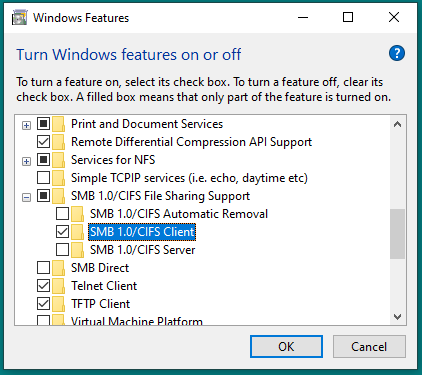
Smb Client Windows 10
For more information on new and changed SMB functionality in Windows Server 2012 R2, see What's New in SMB in Windows Server.
Features added in SMB 3.0 with Windows Server 2012 and Windows 8
| Feature/functionality | New or updated | Summary |
|---|---|---|
| SMB Transparent Failover | New | Enables administrators to perform hardware or software maintenance of nodes in a clustered file server without interrupting server applications storing data on these file shares. Also, if a hardware or software failure occurs on a cluster node, SMB clients transparently reconnect to another cluster node without interrupting server applications that are storing data on these file shares. |
| SMB Scale Out | New | Support for multiple SMB instances on a Scale-Out File Server. Using Cluster Shared Volumes (CSV) version 2, administrators can create file shares that provide simultaneous access to data files, with direct I/O, through all nodes in a file server cluster. This provides better utilization of network bandwidth and load balancing of the file server clients, and optimizes performance for server applications. |
| SMB Multichannel | New | Enables aggregation of network bandwidth and network fault tolerance if multiple paths are available between the SMB client and server. This enables server applications to take full advantage of all available network bandwidth and be resilient to a network failure. SMB Multichannel in SMB 3 contributes to a substantial increase in performance compared to previous versions of SMB. |
| SMB Direct | New | Supports the use of network adapters that have RDMA capability and can function at full speed with very low latency, while using very little CPU. For workloads such as Hyper-V or Microsoft SQL Server, this enables a remote file server to resemble local storage. SMB Direct in SMB 3 contributes to a substantial increase in performance compared to previous versions of SMB. |
| Performance Counters for server applications | New | The new SMB performance counters provide detailed, per-share information about throughput, latency, and I/O per second (IOPS), allowing administrators to analyze the performance of SMB file shares where their data is stored. These counters are specifically designed for server applications, such as Hyper-V and SQL Server, which store files on remote file shares. |
| Performance optimizations | Updated | Both the SMB client and server have been optimized for small random read/write I/O, which is common in server applications such as SQL Server OLTP. In addition, large Maximum Transmission Unit (MTU) is turned on by default, which significantly enhances performance in large sequential transfers, such as SQL Server data warehouse, database backup or restore, deploying or copying virtual hard disks. |
| SMB-specific Windows PowerShell cmdlets | New | With Windows PowerShell cmdlets for SMB, an administrator can manage file shares on the file server, end to end, from the command line. |
| SMB Encryption | New | Provides end-to-end encryption of SMB data and protects data from eavesdropping occurrences on untrusted networks. Requires no new deployment costs, and no need for Internet Protocol security (IPsec), specialized hardware, or WAN accelerators. It may be configured on a per share basis, or for the entire file server, and may be enabled for a variety of scenarios where data traverses untrusted networks. |
| SMB Directory Leasing | New | Improves application response times in branch offices. With the use of directory leases, roundtrips from client to server are reduced since metadata is retrieved from a longer living directory cache. Cache coherency is maintained because clients are notified when directory information on the server changes. Directory leases work with scenarios for HomeFolder (read/write with no sharing) and Publication (read-only with sharing). |
| Performance over WAN | New | Directory opportunistic locks (oplocks) and oplock leases were introduced in SMB 3.0. For typical office/client workloads, oplocks/leases are shown to reduce network round trips by approximately 15%. In SMB 3, the Windows implementation of SMB has been refined to improve the caching behavior on the client as well as the ability to push higher throughputs. SMB 3 features improvements to the CopyFile() API, as well as to associated tools such as Robocopy, to push significantly more data over the network. |
| Secure dialect negotiation | New | Helps protect against man-in-the-middle attempt to downgrade dialect negotiation. The idea is to prevent an eavesdropper from downgrading the initially negotiated dialect and capabilities between the client and the server. For details, see SMB3 Secure Dialect Negotiation. Note that this has been superceded by the SMB 3.1.1 Pre-authentication integrity in Windows 10 feature in SMB 3.1.1. |
Hardware requirements
SMB Transparent Failover has the following requirements:
- A failover cluster running Windows Server 2012 or Windows Server 2016 with at least two nodes configured. The cluster must pass the cluster validation tests included in the validation wizard.
- File shares must be created with the Continuous Availability (CA) property, which is the default.
- File shares must be created on CSV volume paths to attain SMB Scale-Out.
- Client computers must be running Windows® 8 or Windows Server 2012, both of which include the updated SMB client that supports continuous availability.
Note
Down-level clients can connect to file shares that have the CA property, but transparent failover will not be supported for these clients.
SMB Multichannel has the following requirements:
- At least two computers running Windows Server 2012 are required. No extra features need to be installed—the technology is on by default.
- For information on recommended network configurations, see the See Also section at the end of this overview topic.
Smb Client Kali
SMB Direct has the following requirements:
- At least two computers running Windows Server 2012 are required. No extra features need to be installed—the technology is on by default.
- Network adapters with RDMA capability are required. Currently, these adapters are available in three different types: iWARP, Infiniband, or RoCE (RDMA over Converged Ethernet).
More information

Smb Client Services
The following list provides additional resources on the web about SMB and related technologies in Windows Server 2012 R2, Windows Server 2012, and Windows Server 2016.