- Dot Product In Word
- How To Type Multiplication & Division Symbol In Word ...
- Word Equation Dot Product
| alpha | kappa | varrho |
| beta | lambda | sigma |
| chi | mu | varsigma |
| delta | nu | tau |
| epsilon | o | upsilon |
| varepsilon | pi | omega |
| phi | varpi | xi |
| varphi | theta | psi |
| gamma | vartheta | zeta |
| eta | rho |
The Formula popup in Word 16. Under Formula, Word takes a guess as to the formula you might want to use and displays ‘=SUM(LEFT)’. Unfortunately, this formula would simply add all the numbers.
Upon click a new window will open up where you can customize equation as shown in the screenshot below, the difference will be Word will be treated this as an object of Microsoft Equation 3.0. You can also check out previously reviewed guides on How to insert watermark in Word 2010 & Track Changes in Word 2010. How to insert other symbols and templates in an equation, see Shortcut keys for inserting symbols and templates into the equation. How to use all these symbols outside the equation, select the option Use Math AutoCorrect rules outside of math regions in the Word Options. How to do it, see Choosing Math AutoCorrect options. Using the Equation Editor Inserting an Equation To insert an equation, do one of the following. Word: Insert / Object / Microsoft Equation 3.0 WordPerfect: Insert / Equation If you are using Word on your home computer, you may want to add the equation editor to the toolbar so that it is much quicker to add equations. Microsoft Word Equation Editor Tutorial Author: Khitron Igal et al Subject: A simple 4-pages tutorial for MS Word equations shortcuts Keywords: Equation editor, equation, Word, Microsoft Word, shortcuts, tutorial, manual, 2010 Created Date: 1/14/2014 2:24:53 PM.
See Shortcut keys for inserting symbols and templates into the equation to find other frequentlyused symbols.
To insert a capital letter of the Greek alphabet, simply enter +Name of the symbol startingwith a capital letter:
| Delta | Phi | Gamma |
| Lambda | Mu | Pi |
| Theta | Sigma | Upsilon |
| Omega | Hi | Psi |
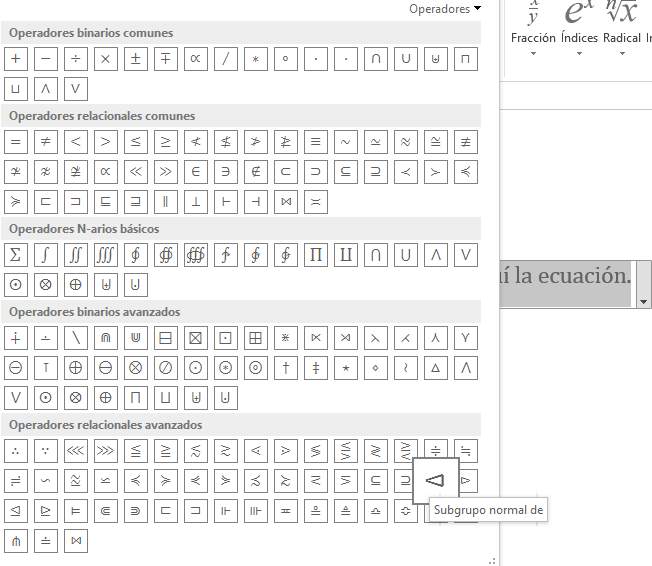
How to insert other symbols and templates in an equation, seeShortcut keysfor inserting symbols and templates into the equation.
How to use all these symbols outside the equation, select the option Use Math AutoCorrect rules outside ofmath regions in the Word Options. How to do it, seeChoosing Math AutoCorrect options.
See also this tip in French:Raccourcisclavier pour entrer des symboles grecs dans équations.
See alsohow to insert X mark in Word.
The division sign ÷ is a mathematical symbol in the form of a colon (∶), obelus (÷), or slash or solidus (/) used to denote the division operator. In most standards, the slash (/) is used as a division sign for linear representation or a fraction bar for structured representation. Symbols ÷ and ∶ can define a data range.
We strongly recommend usingthe Equation tools to insert any type of equation or mathematical, financial, or even logical formulas and expressions.
A lowercase Latin letter X often substitutes the multiplication sign, but this is a mistake that you need to avoid.
To create a perfect document, use one of the following ways to insert a multiplication symbol, or a division sign:
The standard way: using the Symbol dialog box:
To open the Symbol dialog box, do the following:
1. On the Insert tab, in the Symbols group, select the Symbol button, and then click More Symbols...:
2. On the Symbol dialog box:
- Select the symbol you want to insert:
For example:
- The multiplication sign:
- The dot symbol:
- Choose the Symbol font from the Font list, and then select the division symbol:
- Click the Insert button to insert the symbol to the current cursor position.
- Click the Cancel button to close the Symbol dialog box.
Using a shortcut key:
Dot Product In Word
In Microsoft Word, you can use Unicode to insert any of the used symbols:
How To Type Multiplication & Division Symbol In Word ...
| Shortcut key | Symbol | |
|---|---|---|
| Multiplication sign | Type 00d7 or 00D7 (does not matter, uppercase or lowercase) and immediately press Alt+X | × |
| Multiplication X | Type 2715 and immediately press Alt+X | ✕ |
| Vector or cross product symbol | Type 2a2f or 2A2F and immediately press Alt+X | ⨯ |
| Middle dot | Type 00b7 or 00D7 and immediately press Alt+X | · |
| Dot symbol | Type 22c5 or 22C5 and immediately press Alt+X | ⋅ |
| Division sign | Type 00f7 or 00F7 and immediately press Alt+X | ÷ |
The quicker way: using AutoCorrect for Math:
When you work with many documents and often need to paste a single special symbol, you do not need to insert an equation each time. Microsoft Word offers a helpful feature named AutoCorrect. The AutoCorrect options in Microsoft Word propose two different ways to quickly add any special character, or evenlarge pieces of text:
- UsingtheReplace text as you type function of the AutoCorrect options.
- Using the Math AutoCorrect options:
Using this method, you can benefit from the Math AutoCorrect options without inserting an equation. To turn on or turn off the AutoCorrect of the Math symbols, do the following:
1. On the File tab, click Options:
2. In the Word Options dialog box, on theProofing tab, click the AutoCorrect Options... button:
3. In the AutoCorrect dialog box, on the Math AutoCorrect tab, select the Use Math AutoCorrect rules outside of the math regions option:
After clicking OK, you can use any of the listed Names of symbols, and Microsoft Word will replace them with the appropriate symbols:
Word Equation Dot Product
Note: If you do not need the last replacement, click Ctrl+Z to cancel it.